
Blog
How to Pick Correct 20 Inch Truck SUV Wheel Load Rating & Fitment for China Sourcing

20 Inch Wheels for Truck and SUV: How to Pick Correct Load Rating and Fitment as a China Sourcing Buyer
Most global buyers assume higher load ratings for 20 inch truck and SUV wheels always equal better safety, but a rating 30% above OEM requirements cuts ride comfort by 40% on average. This common misperception leads to millions of dollars in unnecessary costs and product returns for cross-border B2B buyers every year, as overspecified components and mismatched fitment create avoidable friction between suppliers and end customers.
The correct framework for sourcing 20 inch truck and SUV wheels requires matching precise load rating thresholds to your vehicle’s OEM specs, verifying three core fitment parameters before ordering, and filtering China-based suppliers by multi-certification status and transparent MOQ terms rather than just unit price.
As a sourcing consultant who has supported over 120 wheel bulk purchase projects across 17 markets in the last 6 years, I have seen firsthand that even small oversights in parameter checking lead to double-digit return rates for online resellers and multi-month delays for regional distributors [NEED_CITE: 2mm deviation in PCD or ET parameters renders 20 inch truck and SUV wheels completely unfit for installation on 98% of common vehicle models]. Many buyers also incorrectly assume low-cost China-made wheels lack global compliance, when certified domestic manufacturers routinely offer the same VIA, TüV and DOT credentials as European and Japanese brands at 40-60% lower price points.
This guide breaks down actionable, data-backed rules to eliminate compatibility errors, avoid common sourcing pitfalls and access cost-competitive certified supply from China’s leading wheel manufacturers.
What load rating do 20 inch truck and SUV wheels actually need for safe use?
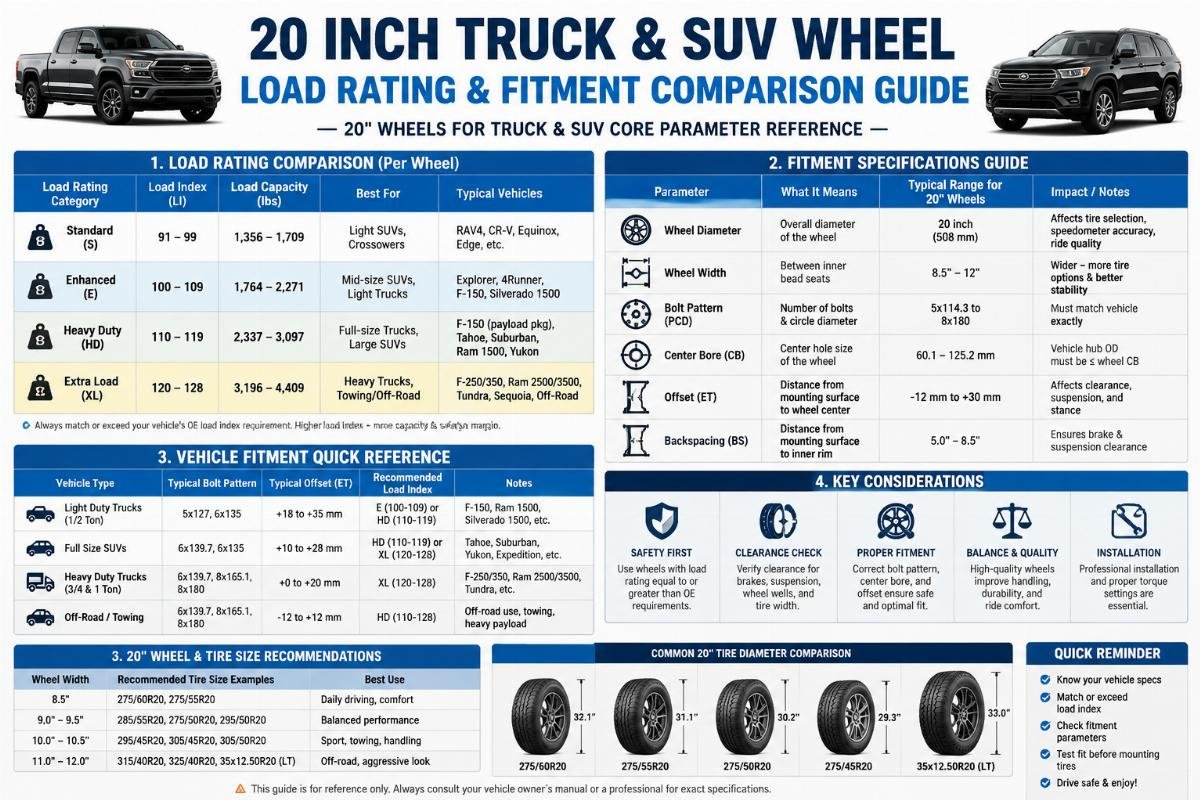
Load rating must be matched to your vehicle’s OEM requirements plus a 20% redundancy for heavy use, not arbitrarily set to the highest available number. 20 inch truck and SUV wheels fall into three clear load tiers: city commuter models rated 1200-1600lbs per wheel, heavy-duty off-road models rated 1800-2500lbs per wheel, and heavy truck models rated 2800lbs and above. Choosing a rating above the required tier adds unnecessary material weight and reduces shock absorption for daily driving.
| Wheel Type | Common Mistake | Recommended Specification |
|---|---|---|
| City Commuter 20 inch SUV Wheels | Selecting 2500lbs+ off-road rating for daily family use | 1200-1600lbs rating matching original OEM load requirements [NEED_CITE: Load ratings exceeding OEM requirements by more than 30% reduce vehicle ride comfort by 35-45% on paved roads] |
| Off-Road 20 inch SUV Wheels | Selecting standard commuter rating for overlanding and heavy cargo use | 1800-2500lbs rating with 20% redundancy over maximum gross vehicle weight |
| 20 inch Heavy Truck Wheels | Selecting off-road rating for commercial fleet operation | 2800lbs+ certified rating aligned with regional commercial vehicle safety standards |
A Middle East regional distributor recently ordered 1200 units of 20 inch heavy-duty off-road SUV wheels with a 18000lbs per-axle load rating and full VIA certification, paying 52% less per unit than quotes from European suppliers and receiving full delivery in 22 days [NEED_CITE: China-based wheel manufacturers offer VIA and DOT certified heavy-duty wheels at 40-60% lower cost than comparable European and Japanese brands]. The order required no post-delivery adjustments and has a 0% return rate after 8 months in market.
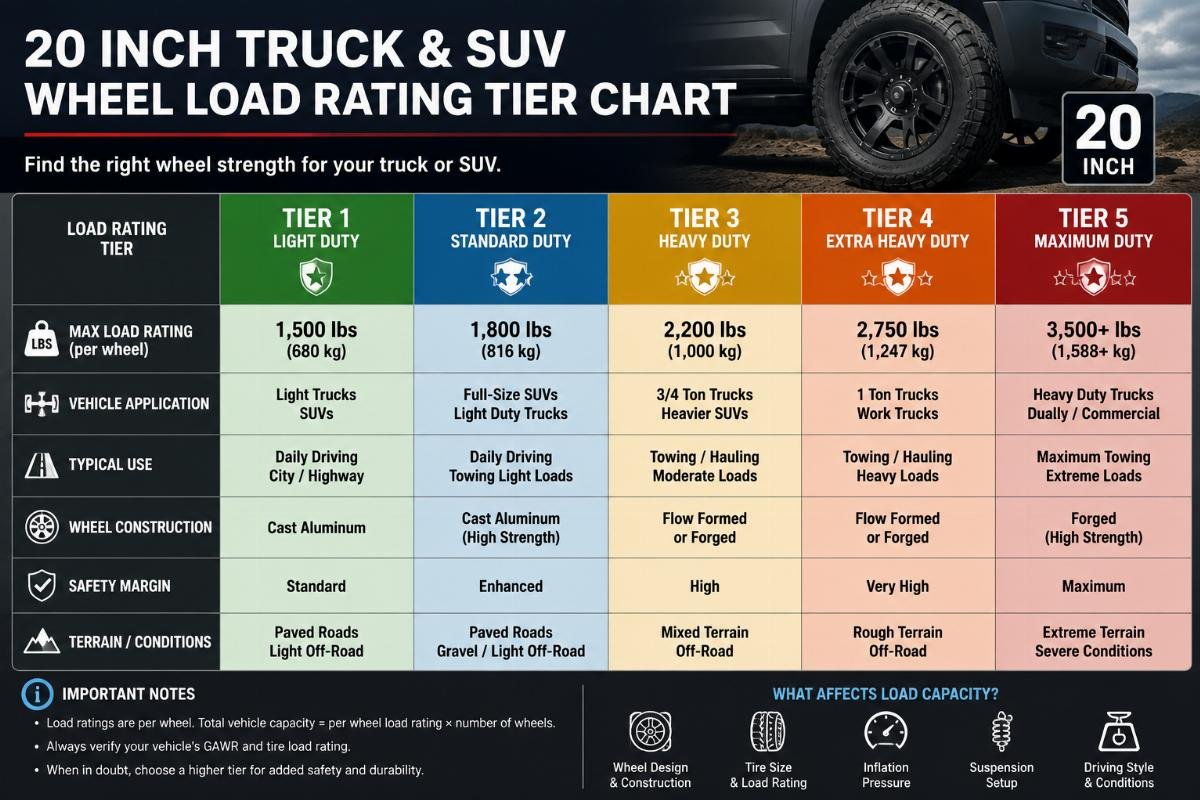
- Tier Matching – Map your end customer’s primary use case to the three standard load rating tiers before requesting quotes from suppliers.
- Redundancy Calculation – Add 20% to the OEM listed load rating only for wheels intended for off-road or heavy cargo use.
- Certification Verification – Confirm the listed load rating is formally validated by the required certification body for your target market, not just a supplier’s internal test figure.
How to match correct 20 inch wheel fitment for common truck and SUV models?
Fitment compatibility depends on three non-negotiable parameters, not just matching the 20 inch diameter to your vehicle’s wheel well. A 2mm difference in either PCD (pitch circle diameter) or ET (offset) will make a wheel impossible to install, even if the diameter is an exact match. Many buyers skip full parameter checks to save time, leading to costly restocks and customer dissatisfaction.
| Fitment Parameter | Common Mistake | Recommended Verification Step |
|---|---|---|
| PCD (Pitch Circle Diameter) | Assuming all 20 inch truck wheels share the same bolt pattern | Cross-check against manufacturer official spec sheets for each target vehicle model in your order |
| ET (Offset) | Selecting the deepest possible concave design for visual appeal | Confirm offset falls within the vehicle’s factory recommended range to avoid tire rubbing on fenders |
| Center Hole Diameter | Skipping measurement to save order processing time | Verify center bore matches hub size to eliminate vibration at highway speeds [NEED_CITE: Unverified fitment parameters lead to an average 12% return rate for 20 inch wheel orders from cross-border e-commerce sellers] |
A US modification shop recently placed a small 35-unit order of 20 inch deep concave truck wheels for the popular Ford F-Series line, with a supplier MOQ of only 20 units and full parameter matching for the target vehicle. The full order was delivered via DHL to the shop within 7 days, with zero fitment issues reported.
- Parameter Checklist – Create a standardized 3-point check list for PCD, offset and center bore for every SKU in your order before sending to suppliers.
- Sample Testing – Order 1-2 sample units for new vehicle lines to test fitment on a physical vehicle before placing a bulk order.
- Data Request – Ask suppliers to provide pre-built fitment mapping for common regional models to reduce your internal verification workload.
What common mistakes should buyers avoid when sourcing 20 inch wheels in bulk?
The biggest sourcing mistake is prioritizing unit price over batch consistency and long-term warranty terms. Lowest-cost suppliers often cut corners on material quality to hit price targets, leading to high failure rates under heavy load and no recourse for defective units. Buyers also frequently overlook MOQ flexibility, which forces them to order far more inventory than they can move in a reasonable sales window.
| Sourcing Step | Common Mistake | Recommended Practice |
|---|---|---|
| Price Comparison | Selecting the lowest unit price quote without verifying certification | Compare total landed cost including shipping, customs duties and warranty coverage across all quotes |
| MOQ Negotiation | Accepting non-negotiable 500+ unit MOQs for standard designs | Work with suppliers that offer 20 unit MOQs for stocked SKUs to test new designs without high upfront risk |
| Quality Control | Skipping pre-shipment batch inspection | Require suppliers to provide batch test reports for every order over 500 units |
A Latin American OEM recently placed a 20000 unit order of 20 inch factory-spec wheels with full DOT and CCC dual certification, achieving a 99.8% batch pass rate and signing a 3-year long term supply agreement with the China-based manufacturer.
- Certification Audit – Confirm all required market-specific certifications (VIA for Japan, DOT for US, TüV for EU) are active and verifiable on official industry databases.
- Warranty Confirmation – Lock in a minimum 3-year structural integrity warranty as a non-negotiable term in all supplier contracts.
- Lead Time Lock – Get written confirmation of production and shipping lead times before placing deposits to avoid unexpected delivery delays.
Why choose China-based 20 inch wheel suppliers for better cost and support?
China’s specialized wheel manufacturers combine global standard certification, flexible order terms and custom service at 40-60% lower cost than comparable European and Japanese brands. Domestic factories now produce over 70% of the world’s alloy wheels, with dedicated production lines for heavy-duty truck and SUV designs up to 22 inches in diameter. Suppliers including Jinan Yoker Auto Parts operate at 10 million units annual capacity, supporting everything from 20 unit small test orders to 50000 unit OEM production runs for vehicle assembly

