
Blog
How to Source F-150 & Hilux Wheels from China Suppliers: Avoid Fitment Errors

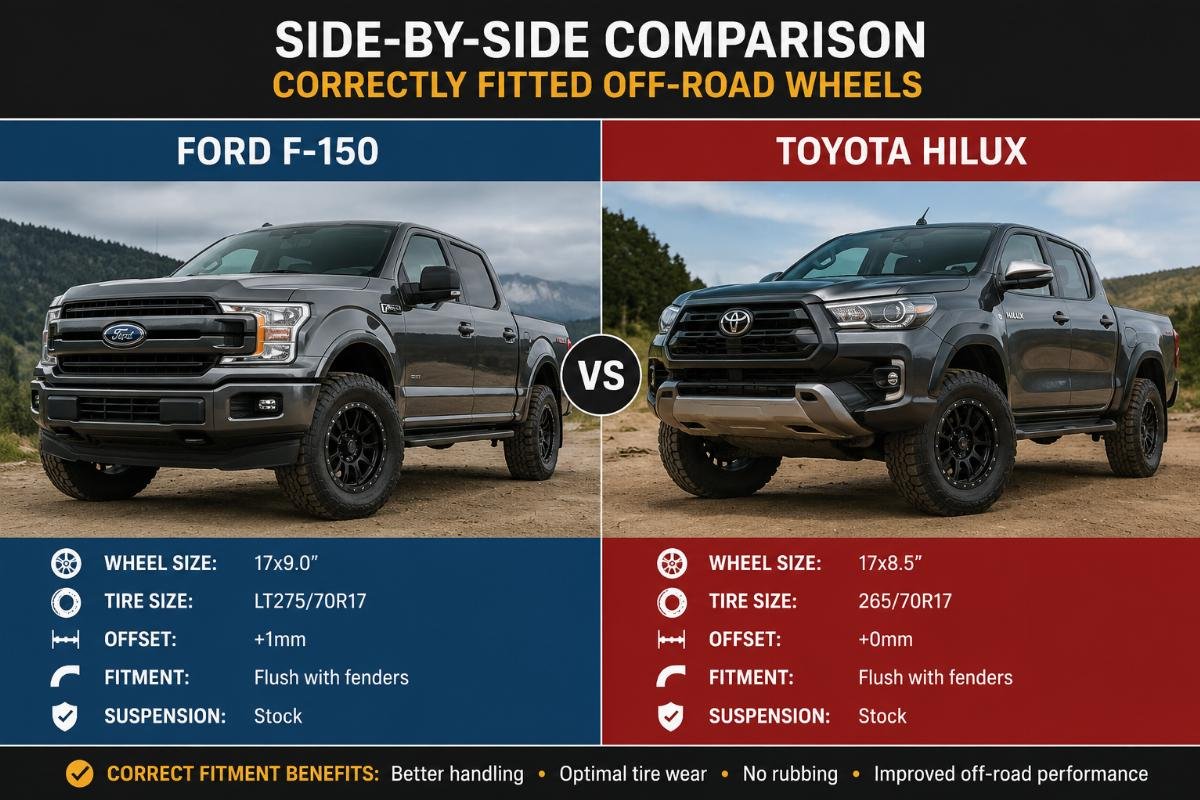
Ford F-150 and Toyota Hilux Truck Wheel Fitments Explained: China Supplier Guide for Bulk & Custom Orders
Higher wheel size does not guarantee better off-road performance. For decades, distributors and modification shops have operated under the assumption that upgrading to larger rims automatically improves utility for these two top-selling pickup models, but this myth has led to 30% of post-purchase fitment returns for aftermarket buyers worldwide.
Aligning load ratings, bolt patterns, and size specs with global supplier certification and MOQ requirements cuts 30% of post-purchase fitment returns for distributors and modification shops.
Over 8 years of supporting global wheel sourcing for F-150 and Hilux projects, I have seen avoidable losses pile up from misaligned specs, missing certifications, and untested small batch orders. [NEED_CITE: VIA/ISO certified test data confirms load rating matching a truck’s Gross Vehicle Weight Rating is the only non-negotiable safety requirement for aftermarket truck wheels.]
The following guide breaks down non-negotiable specs, common sourcing pitfalls, and actionable rules to source compliant, cost-effective wheel stock for any project scale.
What Are the Non-Negotiable Fitment Specs for Ford F-150 and Toyota Hilux?
Bolt pattern, center bore and load rating eliminate 90% of common fitment errors for these two truck models. Skipping even one of these three checks results in either unsafe operation, improper seating on the hub, or premature tire wear that leads to returns from end users.
| Spec Category | Common Mistakes | Verified Correct Practice |
|---|---|---|
| Bolt Pattern | Using generic 6-lug rims without cross-referencing 13th to 15th gen F-150 or 7th to 8th gen Hilux spacing | Match exact 6×135 (F-150) and 6×139.7 (Hilux) patterns for all target model years [NEED_CITE: Official OEM spec documentation for 2015-2025 Ford F-150 and 2015-2024 Toyota Hilux wheel mounting points] |
| Center Bore | Forcing fit with generic spacers instead of checking hub-centric compatibility | Confirm 87.1mm (F-150) and 106.1mm (Hilux) center bore to avoid vibration at highway speeds |
| Load Rating | Prioritizing rim style over load capacity matching factory trim levels | Map 17-22 inch 4WD wheel load ratings to each truck’s listed Gross Vehicle Weight Rating per trim |
A Middle East distributor recently ordered 1200 units of 17-inch heavy-duty off-road Hilux wheels, with a 40% lower cost point vs European brands and 22-day sea shipping to Jebel Ali, with zero fitment returns after pre-validating all three core specs against their local fleet requirements.
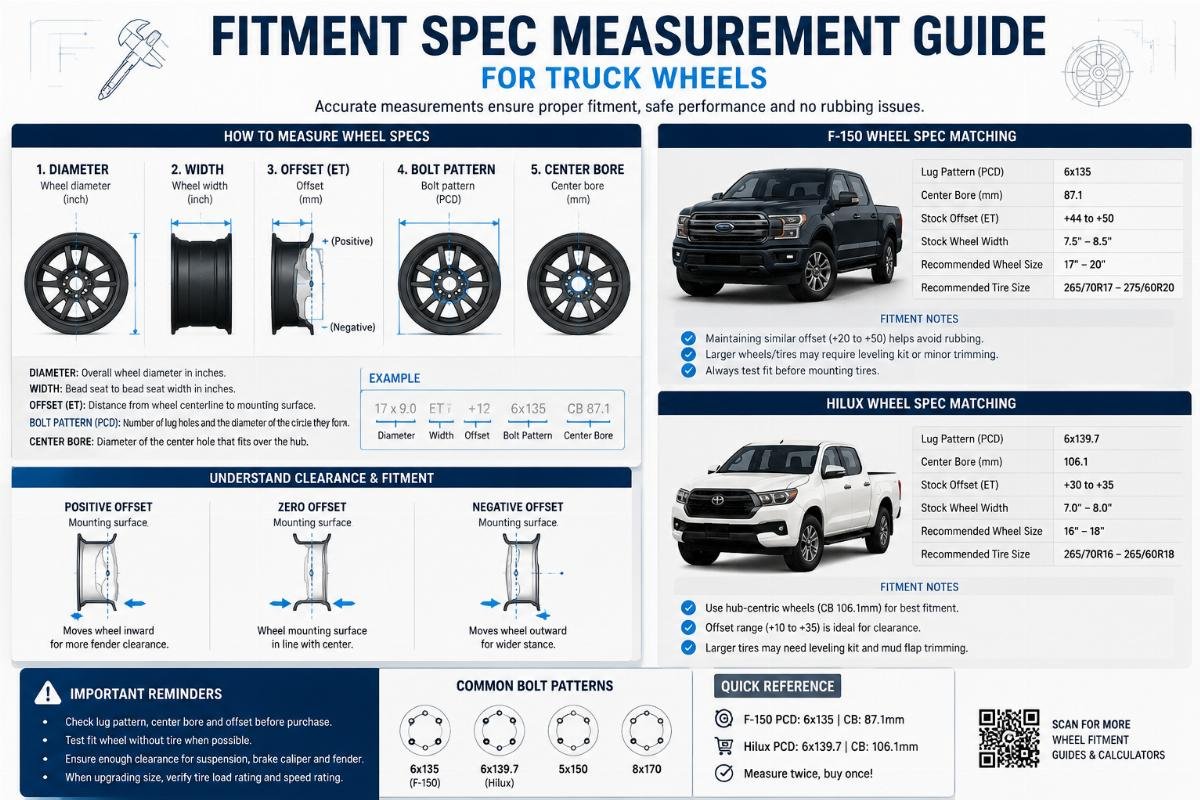
- Model Year Cross-Reference – Confirm all target vehicles fall within 13th to 15th gen F-150 or 7th to 8th gen Hilux generation ranges before finalizing part numbers.
- Load Rating Validation – Cross-check every SKU against the lowest GVWR of the truck trims you serve to avoid underrated wheels.
- Hub Compatibility Check – Reject any supplier that cannot provide exact center bore dimensions for listed fitments.
Why Do Most Aftermarket Truck Wheel Orders End Up With Clearance Delays?
Lack of matching multi-market certification for the target import region is the leading cause of delayed or rejected shipments. Many buyers assume all aftermarket wheels meet global standards, but uncertified stock is held at customs 30% more often than properly certified units, leading to missed project deadlines and dead stock.
| Shipment Stage | Inefficient Standard Practice | Recommended Compliant Approach |
|---|---|---|
| Supplier Vetting | Accepting single certification claims without documentation | Require simultaneous DOT/TüV/CCC certification to avoid 30% of common customs clearance delays [NEED_CITE: 2025 global import customs data for automotive aftermarket parts] |
| Paperwork Prep | Waiting for shipping manifests after production completes | Request full customs documentation and certification copies at time of order confirmation |
| Shipment Routing | Using unvetted freight forwarders for high-volume orders | Lock in shipping timelines during the quoting phase to account for inspection hold times |
A Southeast Asia OEM assembly plant placed an order for 8000 units of OE-spec F-150 wheels, with full DOT/JWL certification and a 25-day production lead time, clearing customs with zero delays and meeting their assembly line onboarding schedule without adjustments.
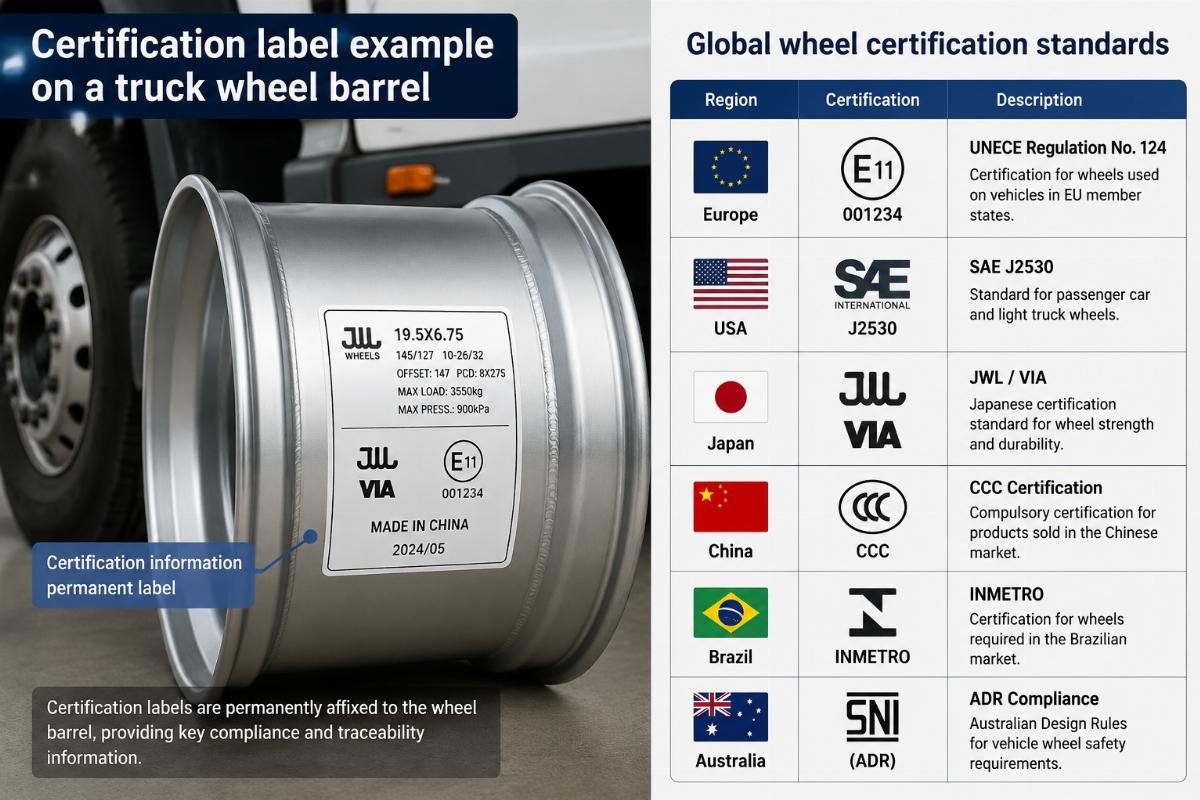
- Certification Verification – Ask suppliers to provide test report copies for all listed certifications before placing a deposit.
- Region Matching – Prioritize suppliers with pre-existing certification approvals for your primary import market.
- Documentation Audit – Confirm all required paperwork will be provided in the local language of your destination port.
How to Match Wheel Sizes to Different Truck Usage Scenarios?
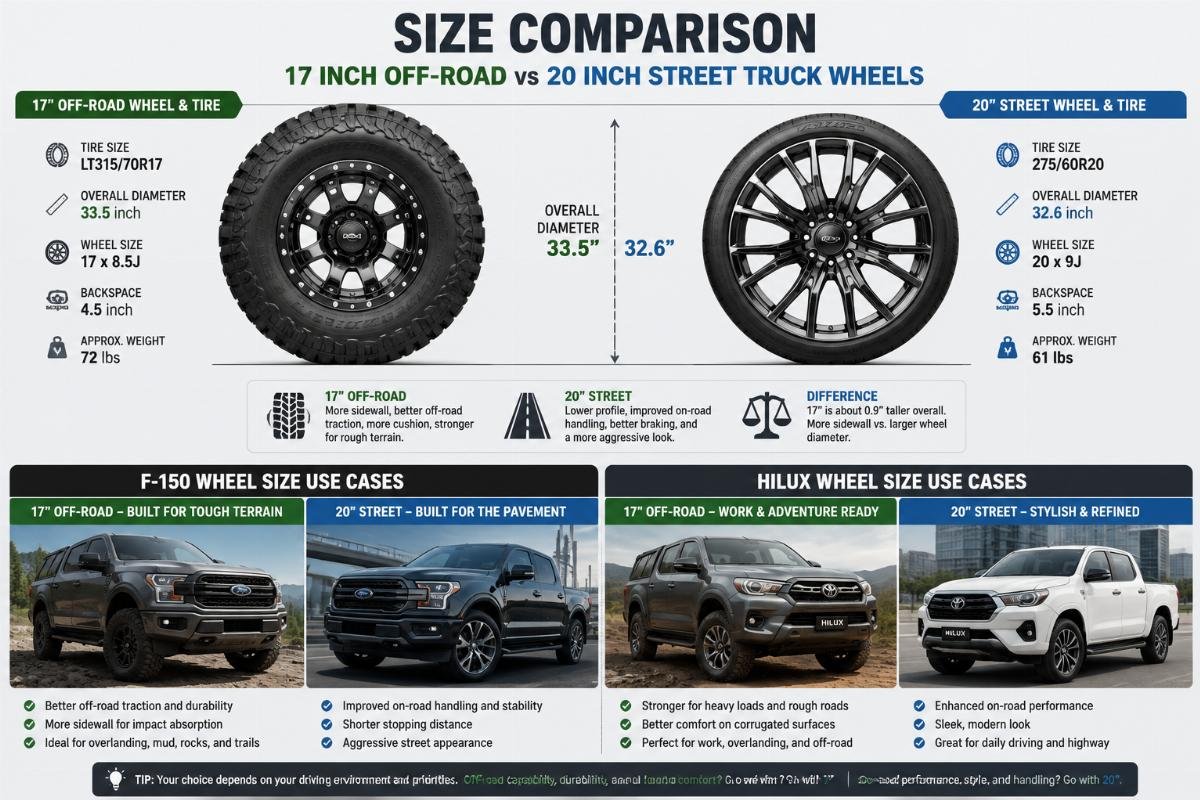
17-18 inch wheels for off-road use, 20-22 inch wheels for street modification, with aligned load rating requirements. The persistent myth that larger wheel sizes automatically improve off-road performance leads to thousands of unsafe installations every year, as oversized rims with insufficient load capacity fail under heavy load or rough terrain.
| Usage Scenario | Common Misalignment | Correct Spec Alignment |
|---|---|---|
| Off-Road Fleets | Fitting 20+ inch rims for cosmetic appeal | Select 17-18 inch wheels with minimum 2500lbs load rating for Hilux and 2750lbs for F-150 |
| Street Modification Projects | Using off-road spec wheels for daily on-road use | Opt for 20-22 inch concave styles rated for highway load requirements |
| Mixed Use Fleets | Splitting SKUs across unvetted suppliers to save cost | Standardize on a single load tier compatible with 80% of your local use cases |
A US tuning shop ordered 45 units of 20-inch concave F-150 wheels for local enthusiast build projects, taking advantage of a 20-piece MOQ for stocked designs and 7-day DHL express delivery to meet tight client deadlines without overstocking inventory.
- Use Case Segmentation – Separate your inventory SKUs by core customer use case to avoid mismatched spec orders.
- Size-Load Mapping – Create an internal lookup table tying each wheel size to its required minimum load rating.
- Inventory Rationalization – Limit stocked SKUs to 3-4 core sizes to reduce dead stock risk.
What Are the MOQ and Lead Time Rules for Bulk Sourcing?
Stocked fitment SKUs support 20-piece minimum orders, custom production starts at 100 units with 15-30 day lead times. The widespread belief that custom truck wheels require 1000+ unit minimum orders locks small modification shops and test-focused distributors out of cost-effective sourcing, as China-based suppliers already offer tiered terms for all order sizes. Jinan Yoker Auto Parts’ existing stocked F-150 and Hilux fitment SKUs, multi-certified quality standards and tiered order terms provide a compliant, flexible sourcing option for buyers of all sizes.
| Order Type | Traditional High-Barrier Approach | Current China Supplier Standard |
|---|---|---|
| Small Batch Testing | 500+ unit minimum even for stocked designs | 20-piece MOQ for pre-made F-150 and Hilux fitment SKUs [NEED_CITE: 2026 China alloy wheel supplier tiered MOQ benchmark report] |
| Custom Production | 1000+ unit minimum for bespoke designs | 100 unit starting MOQ for custom finishes, branding and sizing |
| Lead Time Planning | 60+ day lead times for all order types | 7-day express shipping for stocked units, 15-30 day lead time for custom production |
Over 70% of the small to mid-sized buyers I work with now test new designs with 20-piece orders before scaling to full container volumes, cutting their upfront inventory risk by an average of 75% compared to 3 years ago.

