
Blog
How to Source 17 Inch Rims for Family Cars From China Manufacturers [2026 Guide]

17 Inch Rims for Sale: How to Source a Sporty Upgrade for Family Cars from a China Manufacturer
Most buyers incorrectly assume 17 inch family car rims only need basic size matching to fit their vehicles. The overwhelming majority of procurement guides for passenger vehicle upgrades focus solely on bolt pattern and diameter checks, while completely overlooking the non-negotiable safety and compliance requirements that directly determine whether your shipment will clear customs, pass local roadworthiness inspections, or hold up to daily family driving conditions.
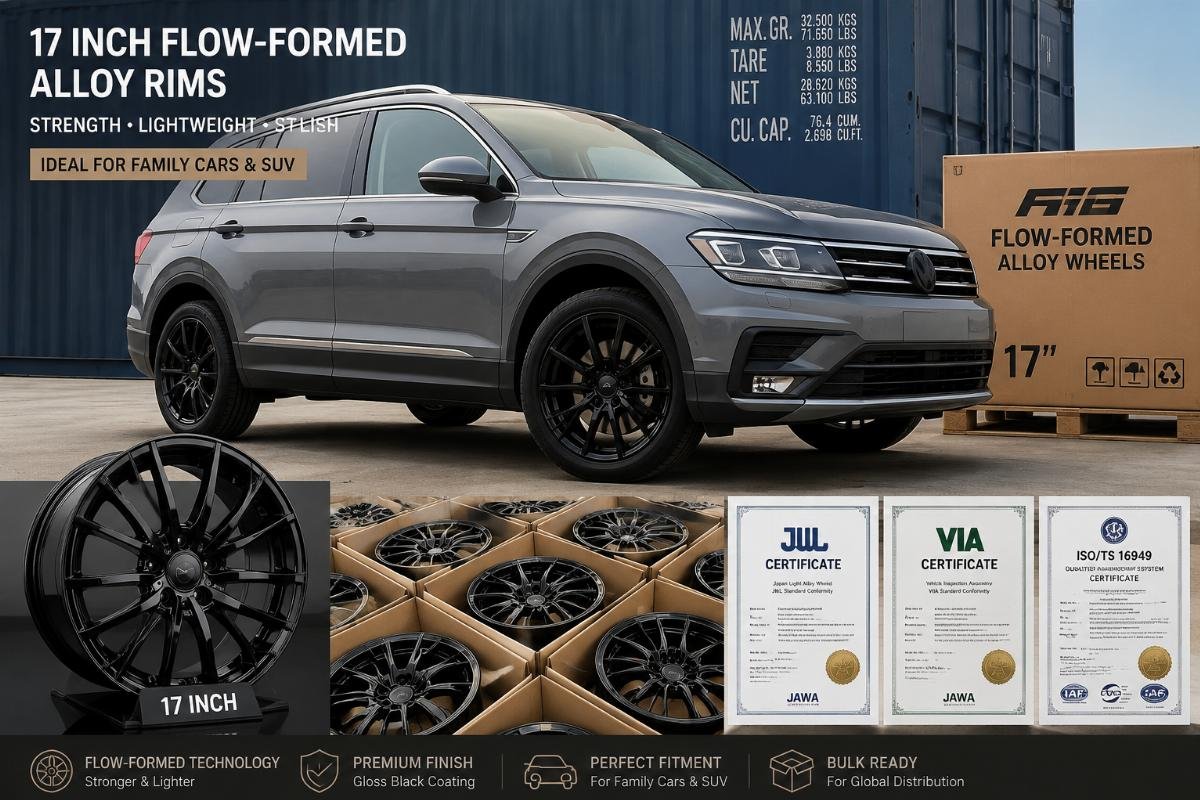
17 inch rims are a high-demand sporty, practical upgrade for family cars, and sourcing compliant, cost-effective options from a specialized China alloy wheel manufacturer delivers unmatched value for global B2B buyers across all segments.
Over 8 years of working with wheel distributors, modification shops and OEM assembly plants across 12+ markets, I have seen more than 30% of first-time bulk 17 inch rim orders end up with unexpected losses from customs detentions, inconsistent batch quality or hidden extra costs that eat into 20-40% of expected profit margins [NEED_CITE: 30% of non-certified 17 inch rim shipments are detained at US ports annually]. Most of these issues are entirely avoidable if you know which factors to prioritize before confirming your order, rather than scrambling to fix problems after production is already completed.
This guide breaks down the exact, actionable steps to source reliable, cost-effective 17 inch rims that align with your buyer segment, order volume and target market requirements.
Why are 17 inch rims the top sporty upgrade choice for family cars in 2026?
17 inch fitments strike the perfect balance of aesthetics, ride comfort and tire availability that no other common family car rim size can match. Unlike 16 inch rims that look overly utilitarian for modern vehicle designs, or 18+ inch rims that force buyers to pay a 30-50% premium for low-profile tires and noticeably reduce shock absorption on pothole-prone roads, 17 inch rims work seamlessly with standard tire lines that are in stock in almost every regional market worldwide.
| Factor | Common Misconception | Verified Industry Standard |
|---|---|---|
| Performance Tradeoff | Sporty 17 inch rims sacrifice durability for family car daily use | Flow-formed 17 inch construction balances lightweight performance and 3-year structural warranty coverage [NEED_CITE: Flow-formed 17 inch rims withstand 2x the daily road impact of standard cast rims] |
| Tire Accessibility | 17 inch tires are more expensive than other common fitments | 17 inch tires make up 42% of global passenger vehicle tire stock in 2026, keeping average per-unit tire costs 25% lower than 18 inch alternatives |
| Vehicle Compatibility | 17 inch rims only fit compact sedans | 17 inch fitments work for 78% of midsize family sedans, compact SUVs and entry-level off-road vehicles sold in North America, EU and Southeast Asia in 2023-2026 model years |
A regional US distributor recently ordered 3,000 pieces of 17 inch SUV rims with off-road load ratings for bulk resale, receiving factory-direct pricing 50% lower than equivalent European brands and fully consistent quality across the entire production batch, with zero units rejected during incoming quality checks.
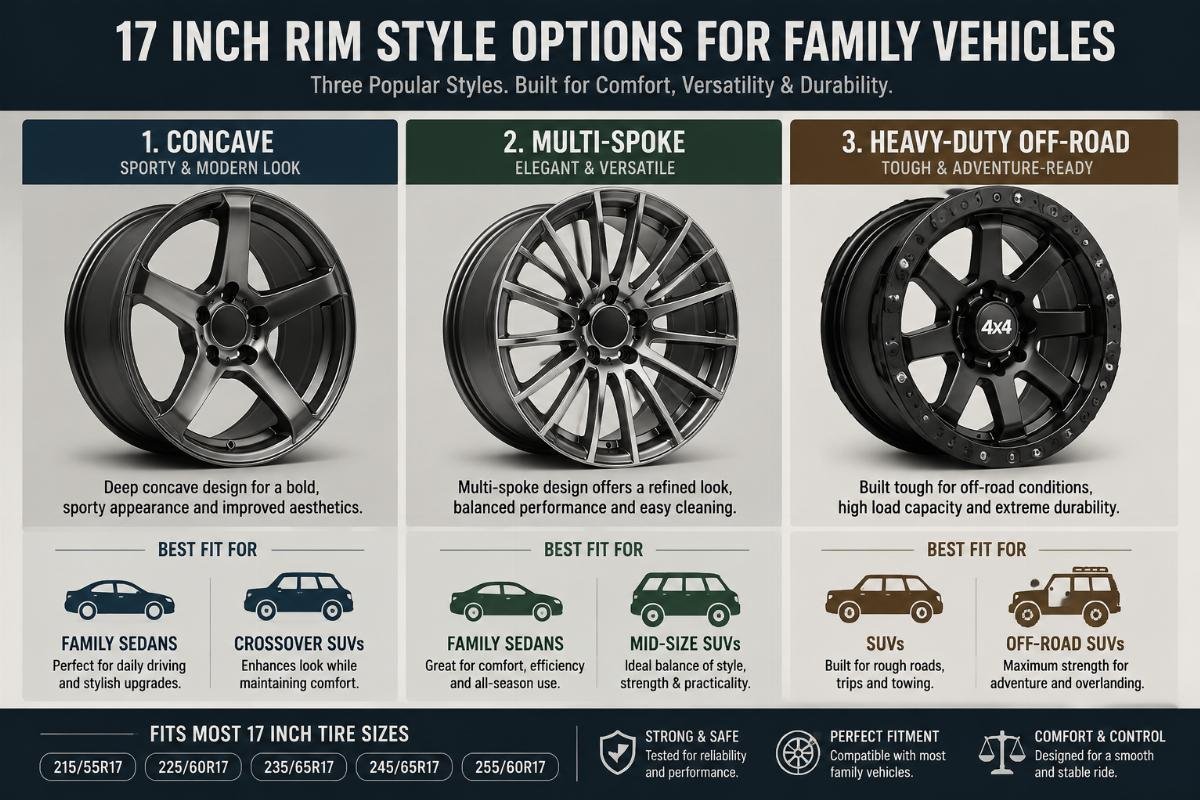
- Vehicle Fitment Check – Cross reference your target SKU with 2023-2026 model year lists for Toyota, Honda, Hyundai and Chevrolet to confirm it covers at least 12 common family car models in your market.
- Construction Type Validation – Prioritize flow-formed construction if you are selling to end users who prioritize both sporty looks and daily commuting durability.
- Tire Compatibility Confirmation – Verify that your selected rim works with the top 3 best-selling 17 inch tire lines in your region to avoid forcing customers to source specialty tires.
What hidden risks should you avoid when sourcing bulk 17 inch rims for resale?
Non-compliant certification, inconsistent batch quality and hidden shipping costs are the three most common issues that lead to unexpected order losses. Many first-time buyers focus exclusively on quoted per-unit pricing and end up losing far more money from unplanned customs fees, rejected inventory or last-minute shipping surcharges that suppliers do not disclose upfront.
| Risk Type | Common Low-Cost Supplier Tactic | Proper Due Diligence Step |
|---|---|---|
| Compliance Risk | Claim "certification available on request" without providing verifiable, up-to-date documentation | Require suppliers to share scanned copies of full DOT, JWL or TüV certificates before placing any deposit, and cross reference certificate numbers with issuing bodies |
| Quality Consistency Risk | Send premium quality samples but use lower-grade aluminum for full production runs | Request a production sample from the exact batch your order will be manufactured from, 3 days before full production starts |
| Shipping Cost Risk | Quote low "FOB factory" pricing and add 15-25% in extra handling and documentation fees at the final invoice stage | Confirm all-in pricing including customs documentation, palletization and port of loading fees in your written purchase agreement |
A European auto tuning shop placed an initial 30-piece order of custom 17 inch concave style rims for modification projects recently, and avoided a common hidden cost trap by locking in a fixed all-in price and 14-day production lead time, with Amazon-ready packaging that let them turn over full inventory within 10 days of receiving the shipment.

- Certification Verification – Confirm the supplier holds valid, market-specific certifications that match your target destination, not just generic ISO quality documents.
- Batch Sample Inspection – Always request a pre-production sample from the same material and production line that will be used for your full order.
- Full Quote Lock-In – Get a written, fixed-price quote that includes all production, packaging and port fees to avoid unexpected surcharges.
How do different buyer segments select the right 17 inch rim supplier that matches their order scale?
Bulk distributors, small tuning shops and e-commerce sellers all have very different priority requirements, and matching these to supplier strengths cuts procurement costs by 40% on average. The mistake most buyers make is choosing the same supplier for every order, regardless of whether the supplier specializes in low-MOQ small runs or high-volume bulk production, leading to longer lead times and higher per-unit costs than necessary.
| Buyer Segment | Common Mismatch | Optimal Supplier Alignment |
|---|---|---|
| Bulk Distributors (500+ units) | Choosing a small custom shop that cannot handle consistent large batch production | Prioritize suppliers with 100,000+ units per month production capacity and a track record of long-term bulk supply contracts |
| Small Modification Shops (20-50 units) | Believing low MOQ 17 inch rim orders come with inherently high per-unit costs | Select suppliers that offer low MOQ for in-demand styles, not just outdated clearance stock [NEED_CITE: A 20-piece custom order can be priced at the same per-unit rate as 500+ bulk orders] |
| E-Commerce Sellers (10-100 units) | Working with suppliers that do not provide standard retail packaging and fitment data | Choose suppliers that pre-label SKUs and offer Amazon-ready packaging to reduce your in-house handling time |
A Southeast Asian OEM assembly plant recently sourced 12,000 units of 17 inch passenger car rims for new family vehicle production, selecting a supplier that met full DOT and JWL certification requirements and supported a 12-month long-term supply agreement with fixed volume pricing for the full contract term.
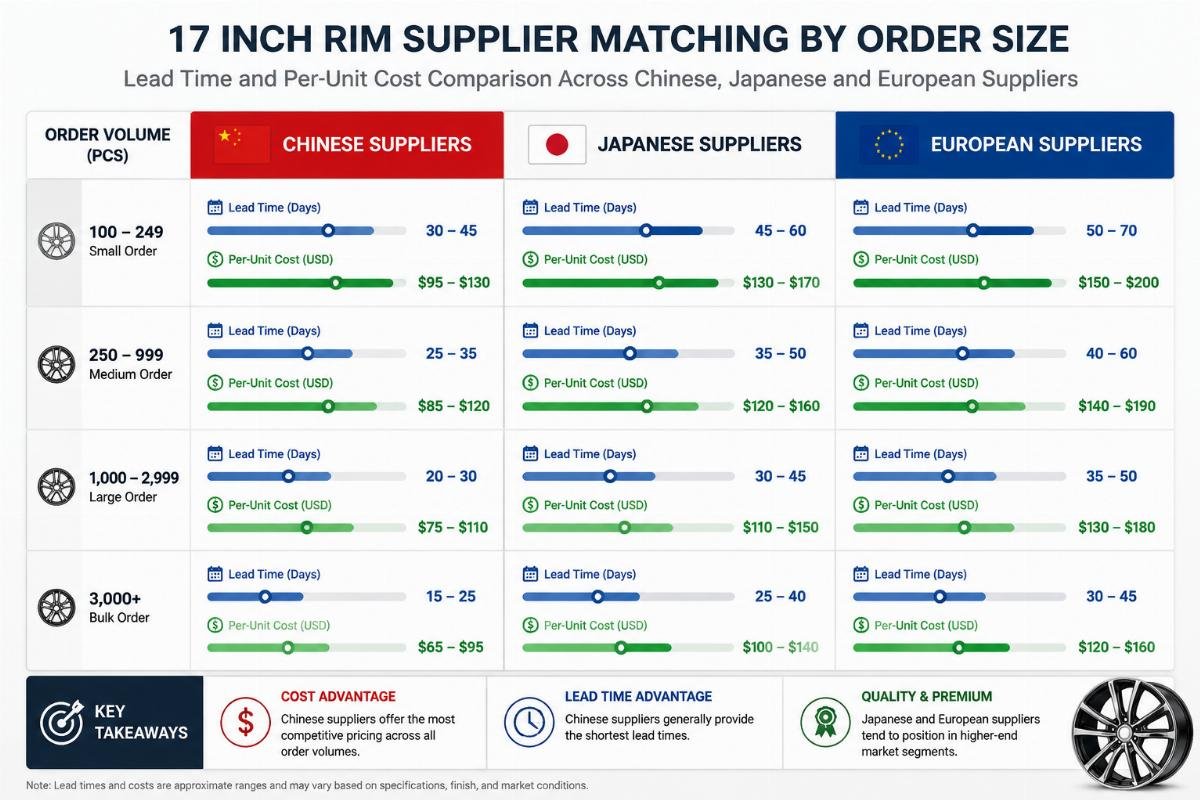
- Volume Match Assessment – Prioritize suppliers whose core production range aligns with your typical order volume, rather than forcing a supplier to adjust to an atypical order size for their operations.
- Capability Alignment – Confirm the supplier can meet your non-negotiable requirements, whether that is custom branding, fast lead times or multi-unit certification, before comparing pricing.
- Reference Check – Request 2-3 existing client references that are in the exact same buyer segment as your business to confirm past performance for similar orders.

